That is how most phone pictures lose. The subject was fine. The background was loud, and nobody asked it to quiet down before the shutter.
If you want to know how to avoid busy backgrounds in photography without a studio, this is the short version: move, wait, or change your angle until the backdrop earns its place. The rest is noticing the problem while you still have time to fix it.
What counts as a busy background
Anything that pulls harder than the person you meant to photograph. A red sign. A stranger's face. A plant that looks like antlers. A window full of reflections. Even a clean wall can turn busy if a streetlight sits on someone's head.
You do not need a ruined street. One sharp distraction at the edge of the frame is enough. Your eye goes there first. Then it tries to come back. The photograph feels restless the whole time.
Color does the same job as clutter. A pale jacket against a pale wall can disappear. A neon menu board behind a quiet face will win every time. If the loudest color is not on your subject, the backdrop is already arguing.
How to avoid busy backgrounds in photography while you shoot
You fix this with your body, not with a later crop that deletes half the picture. Three moves cover almost every sidewalk and cafe.
Take one step left, or one step closer
Most clutter is to the side of the subject, not behind their spine. A half-step left can put a pale wall behind them instead of a rack of bikes. A step closer can push the mess out of the frame entirely.
Check the edges before you tap. The middle of the photo is usually fine. Trouble lives in the corners.
If you cannot move closer without cutting off a hand, move yourself around them instead. Circle until a quieter plane lines up. You are editing the world with your feet.

 Busy
BusyWait for the interruption to leave
A person walking through, a delivery cart, a dog on a long lead. You do not need to shout. Count to five. The frame often clears itself.
This feels slow when you are with friends. It is still faster than deleting twenty photos that almost worked. Patience is a composition tool, same as a grid.
Keep talking while you wait. People relax when the phone is not jammed in their face the whole time. When the passerby clears, you already have the expression you wanted.
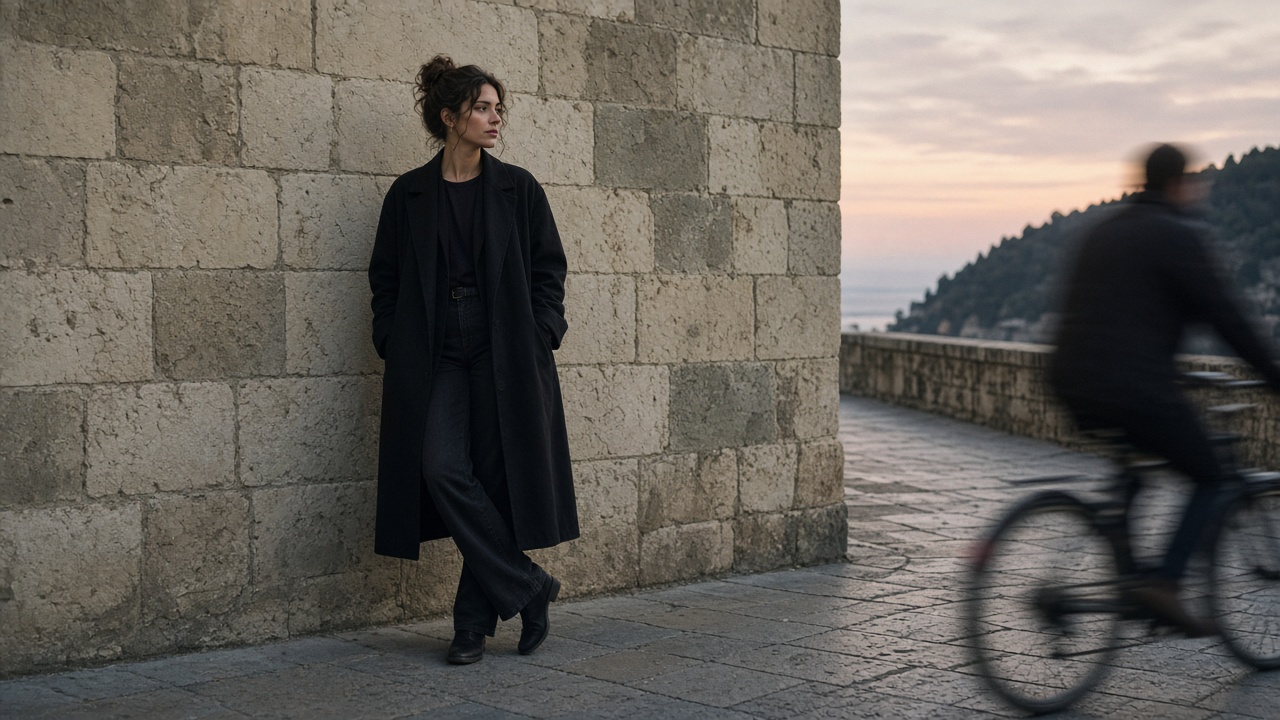
Change height or angle
Crouch and the pastry case disappears. Rise a little and the parked cars sink under the frame. Turn forty-five degrees and a messy shelf becomes a soft wash of window light.
You are not looking for a prettier subject. You are looking for a quieter plane behind them. That is the whole job.
Phones exaggerate depth when you get low. Use that. A low angle can hide a row of chairs and leave only sky or a simple wall, which suddenly looks like you planned the location.

When a busy background is allowed
Sometimes the mess is the story. A market stall. A kitchen mid-service. A kid in the middle of a birthday that looks like chaos because it was.
Then you keep the background, but you decide what it is doing. Put the person on a clear shape inside it. Use a bit of negative space around the face so they do not dissolve into the noise. Or let a leading line cut through the clutter and land on them.
Busy on purpose can work. Busy by accident almost never does. If you cannot explain why the clutter stays, remove it.
A quick check before you tap
Ask one question: what is the loudest thing in this frame? If the answer is not your subject, fix that first. Move. Wait. Turn. Then worry about thirds, horizons, and the rest.
A clean backdrop makes every other skill easier. The rule of thirds looks considered instead of accidental. A level horizon has somewhere calm to sit. You stop fighting the photo after you take it.
Say the backdrop out loud once. “Wall.” “Trees.” “Window.” If you hear yourself say “stuff” or “the street,” you are not done yet.
Practice on one walk
Pick a person you already photograph. Take the first frame from where you are standing. Take a second after you change only the background: one step, a short wait, or a new angle.
Compare them at home. Ignore which smile you like more. Look at which picture lets your eye stay on the face. That is the one that learned the lesson.
Do that ten times and you will start scanning the backdrop before you lift the phone. That scan is the real skill.
Try it indoors too. Kitchens and cafes are full of honest tests: open shelves, coffee machines, other tables. One small turn often swaps a circus for a quiet wall.
Seeing the backdrop in time
Most of us only notice the scooter later, on the couch, when the moment is gone.
We built Framewiser for the second you are still in. Open it on your iPhone and a quiet nudge arrives in the viewfinder before you tap: the background is stealing the shot, move slightly, give them a cleaner wall. Eventually you catch the clutter yourself.
Until then, make the backdrop earn its place. Get the app on the App Store if you want that coach beside you while you walk.