Leading lines are one of those composition ideas that sound obvious until you try them on a Tuesday. A path, a railing, a row of windows. The photograph is supposed to follow them to the subject. In practice you get a lot of pictures of kerbs.
This is the version I actually use when I'm out walking.
What a leading line actually is
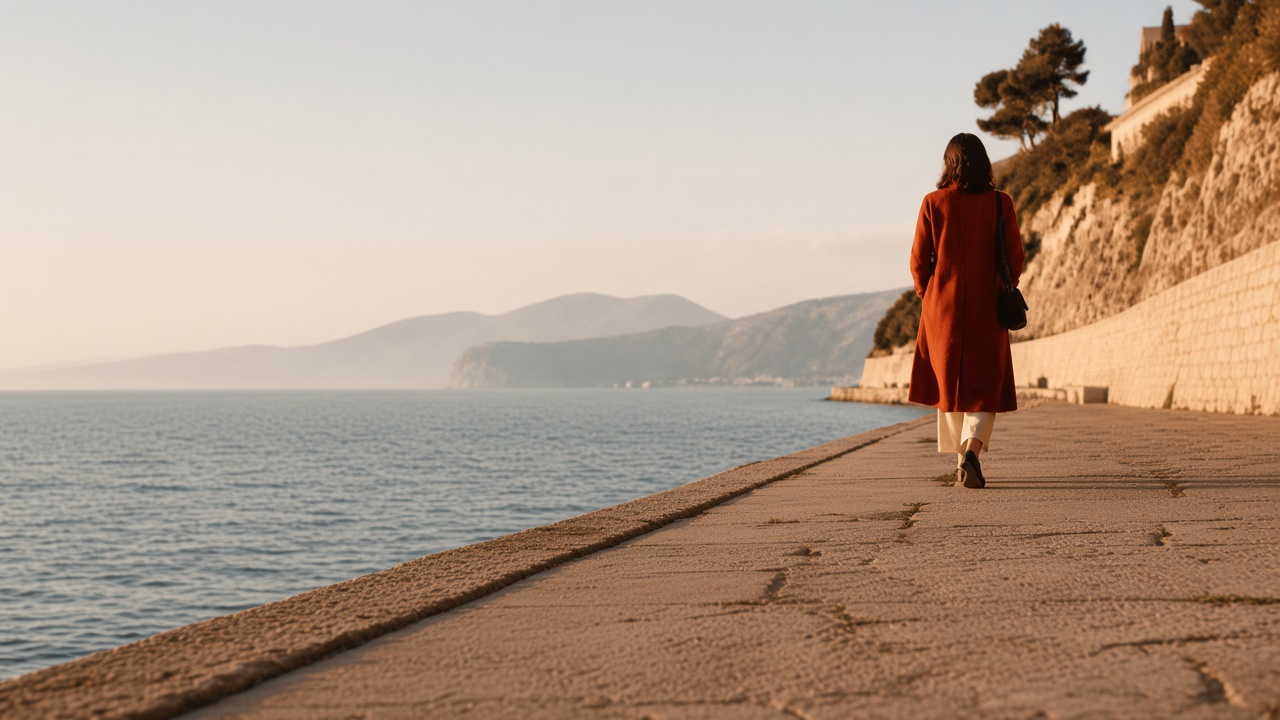
A leading line is anything in the frame that points. It can be a real edge, like the lip of a sea wall, or something softer, like a shadow stretching across a courtyard. The eye treats it as a path and walks it.
That only helps if the path ends on the thing you meant to photograph. A line that runs off the edge of the frame, or dies in a parked scooter, is just a line. Pretty, sometimes. Useless as a guide.
You do not need a vanishing point, or a railway, or a tutorial shot of train tracks at dusk. Most of the useful lines in ordinary life are short. A table edge. The curb. The crack between two paving stones if the light is low enough to make it dark.
Where you will actually find them
A path that already knows where it is going
Sea walls, corridors, the walk from the station. The line is handed to you. Your job is to stand where it enters the frame from a corner, or from the bottom edge, and then check what it hits.
If it hits your friend, good. If it hits an empty bit of horizon, you have a landscape with a stripe in it. Move until the person, the tree, the doorway sits at the end of that stripe. One step to the side usually changes the meeting point more than you expect.
Shadows, which are free and temporary
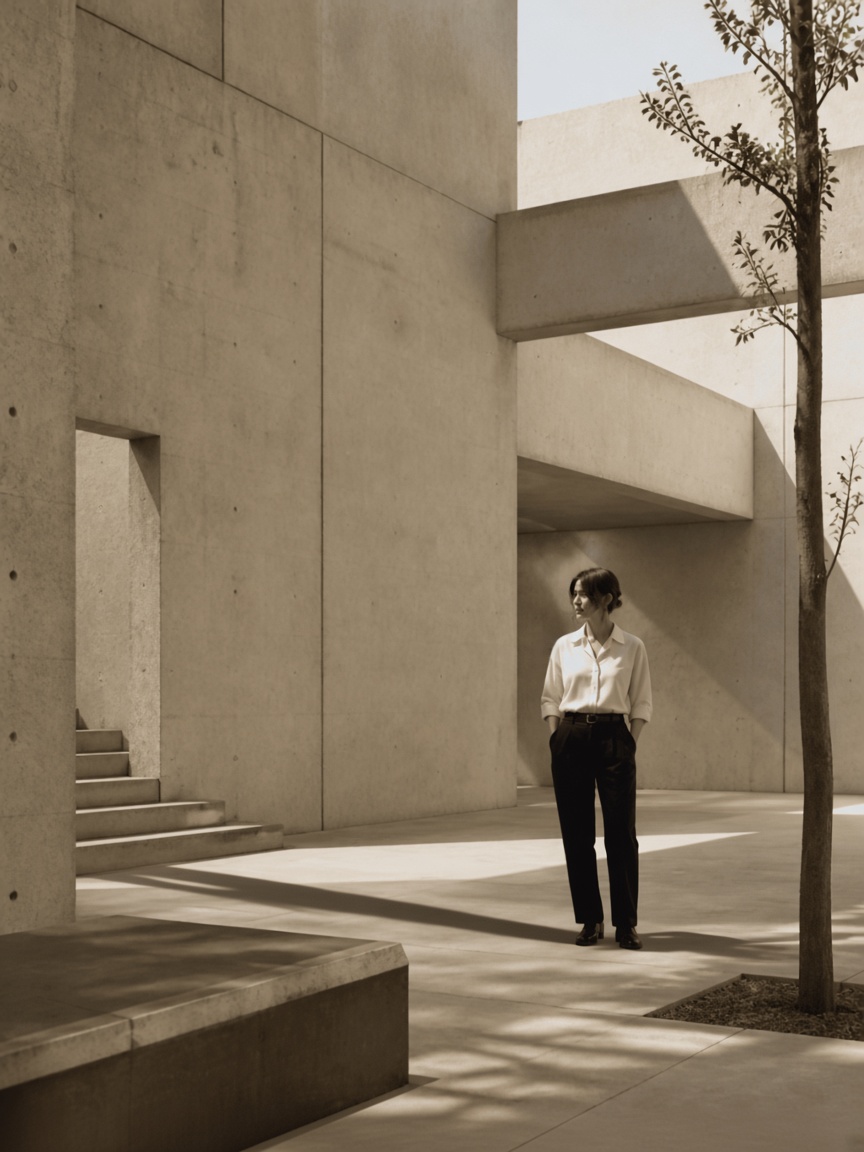
Late afternoon in a courtyard. A beam, a tree, a railing you cannot even see, all of them throwing a dark bar across the ground. That bar is a line with a deadline. In twenty minutes it will have moved, or gone.
I wait for the shadow to touch the person, or to stop just short of their shoes, and then I take the picture. If I shoot while the shadow is still crossing empty concrete, the line has nowhere to land. The person looks pasted on afterwards.
Phone cameras handle this fine. You do not need a longer lens. You need to be standing in the right square of ground when the light is still doing the work.
A doorway, a window, the gap between two stalls
Frames are leading lines that have closed into a box. The eye goes to the opening because everything else is wall. Put the person in that opening and you barely have to think about the rest.
The mistake is standing square-on and getting a passport photo with architecture around it. Step to one side so one jamb is closer than the other. The opening stops being a hole and starts being a direction.
This stacks well with the rule of thirds. The doorway can sit on a third, and the person can sit in the gap. The wall is the line. The third is where you park the face.

When the line is making the photo worse
A busy street has too many candidates. Railings, road markings, the yellow line, someone's suitcase handle. If you include all of them, the eye does a lap of the frame and leaves.
Pick one. Crop the others out with your feet, not later with an app. Crouch so the railing clears the subject's head. Wait until the cyclist who was cutting across your path has gone. A single clean line beats three competing ones, even if the three look more "composed" on a grid.
Also watch where the line exits. If it leaves through the top of the frame before it reaches anyone, the photograph feels unfinished, like a sentence that stopped. Either include the destination or drop the line.
A walk you can do this week
Go outside for twenty minutes with the phone and one rule: you only press the shutter if you can name the line out loud. "The curb." "The shadow." "The shopfront." If you cannot name it, you are guessing, and the picture will look like a guess.
Take two frames each time. One from where you were already standing. One after you move so the line meets the subject. Compare them at home, not on the pavement, where every photo looks fine because you remember being there.
Ten of those pairs is enough. After that you start noticing the line before you lift the phone, which is the only version of this that is useful.
Seeing the line before you shoot
Knowing the term is the easy part. The rest is noticing the path while your friend is talking and the light is leaving. By the time you review the photo, the shadow has moved.
Framewiser is for that second. Open it on your iPhone, point it at the path, and it nudges you before you tap: step left, the line is about to miss them. After a while you stop needing the nudge. You just stop walking when the path lines up.
Until then: one line, one subject, and one step before the button.